
What agentic automation actually is
Agentic automation is the use of AI agents, software components that can interpret a goal, plan a sequence of actions, call tools or systems to carry them out, and adjust based on what happens, combined with the orchestration, governance, and execution infrastructure that turns that behavior into something an enterprise can run safely and repeatedly.
The word doing the heavy lifting is “agentic.” An agent is not just a model that answers a question. It is a system that can take a goal such as “resolve this customer’s billing dispute,” break that goal into steps, decide which system to check first, retrieve the account history, apply a policy, take an action such as issuing a credit, and only escalate to a person when it hits a case the policy did not anticipate. It does this without being told the exact sequence of clicks in advance, which is the fundamental difference from the automation that came before it.
Automation vendors and analysts do not all use the term identically, and the category is still settling. Gartner’s own research treats agentic AI as a broad, unevenly maturing ecosystem rather than a single product category, spanning agent development practices, orchestration platforms, context management, and governance tooling, all evolving at different speeds.
The anatomy of an agent
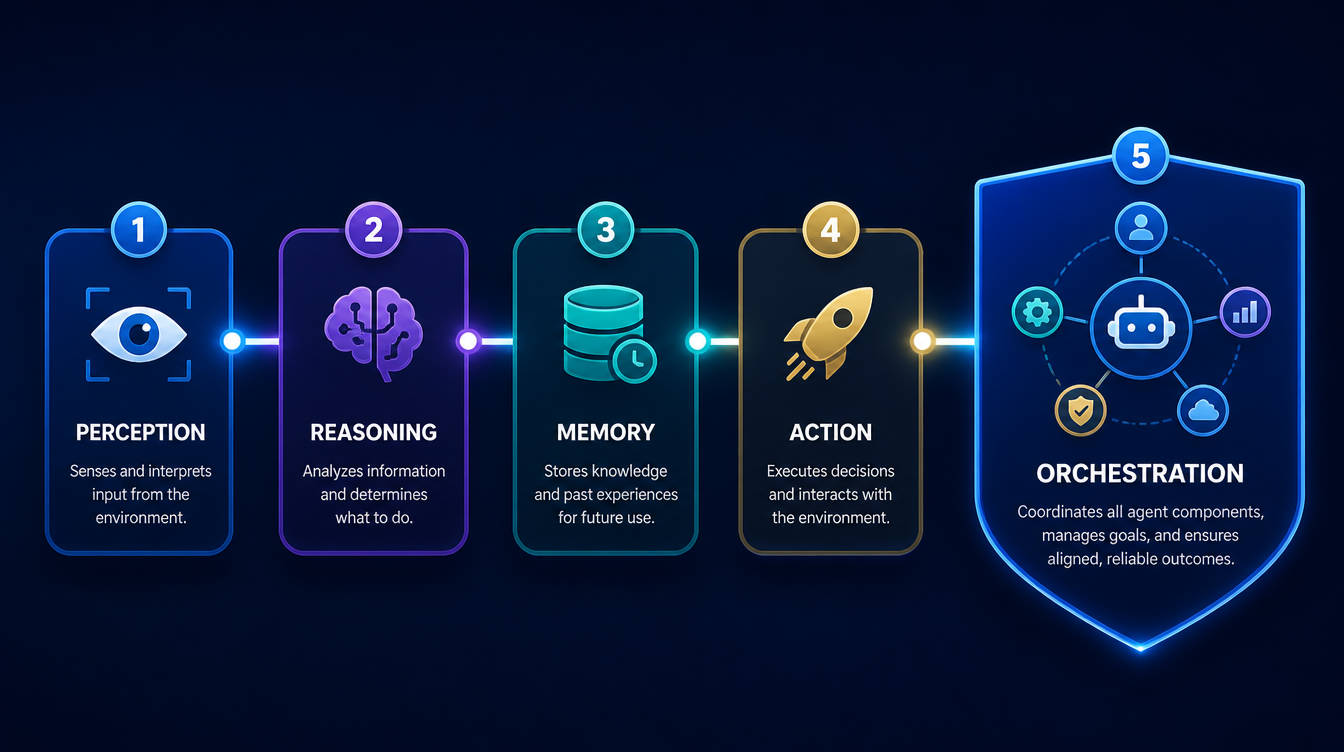
Strip away the marketing and most agentic systems share the same five parts. Understanding them is the fastest way to evaluate any vendor’s “agent” claim.
- Perception. How the agent takes in information: reading a document, watching a queue, receiving an API event, or parsing a screen.
- Reasoning and planning. The layer, usually a large language model, that interprets the goal and decides what sequence of steps might achieve it.
- Memory and context. What the agent retains between steps and between runs: the conversation so far, retrieved records, past outcomes. Without this, an agent cannot handle a multi-step or long-running process.
- Action and tools. The concrete capability to do something: call an API, fill a form, update a record, send a message. This is where agentic automation overlaps directly with RPA, since bots are often the hands an agent uses.
- Orchestration and governance. The control plane that decides which agent handles what, enforces permissions, logs every decision, and routes exceptions to a human. This is the layer most narrow “AI agent” demos skip, and the layer that determines whether a pilot survives contact with production.
A useful test when a vendor says their product “has agents”: ask what happens when the agent is wrong. If there is no clear answer involving logging, rollback, or human escalation, you are looking at a demo, not an orchestration layer.
How it differs from RPA and from simple AI assistants
The three terms get used almost interchangeably in vendor marketing, and they should not be.
Traditional RPA vs. AI assistants vs. agentic automation
| Dimension | Traditional RPA | AI assistant / copilot | Agentic automation |
|---|---|---|---|
| How the steps get decided | Fixed script, recorded or coded in advance | Person asks, model answers or drafts | Agent plans steps toward a goal, within set boundaries |
| Handles exceptions | No, breaks or halts on anything unscripted | N/A, no execution happens on its own | Can adapt within policy, escalates what it cannot resolve |
| Takes action in systems | Yes, that is its purpose | Rarely, mostly drafts or suggests | Yes, directly or through RPA bots as tools |
| Where it fits best | High-volume, stable, rules-based processes | Individual productivity, drafting, summarizing | Multi-step processes with judgment calls and exceptions |
| Governance need | Moderate, mostly change control on scripts | Low to moderate | High, decisions and actions both need audit and control |
The practical implication: agentic automation does not replace RPA, it sits above it. Robots remain an efficient, auditable way to take action in legacy applications that do not have clean APIs. What changes is who decides which robot runs when, and that decision moves from a fixed script to a reasoning agent operating inside a governed set of boundaries.
Why this is happening now
Two things converged. Large language models became reliable enough at multi-step reasoning and tool use to plan a process rather than just describe one, and enterprises already had a decade of RPA, orchestration, and process mining investment providing the execution layer for agents to plug into.
Analyst data shows the pace of interest clearly. According to Gartner’s 2026 CIO and Technology Executive Survey, only around 17 percent of organizations have deployed AI agents so far, yet more than 60 percent expect to do so within two years, among the steepest adoption curves Gartner tracks for any emerging technology. Separately, Gartner has forecast that 40 percent of enterprise applications will carry task-specific AI agents by the end of 2026, up from under 5 percent in 2025.
Gartner’s 2026 Hype Cycle places agentic AI at the Peak of Inflated Expectations, meaning attention and adoption intent are running well ahead of proven, repeatable enterprise results. That is not a reason to wait. It is a reason to be precise about which processes are actually ready.
The maturity curve: from assistant to autonomous ecosystem
Most analyst models describe agentic maturity as a progression rather than a switch. A commonly cited version, reflected in Gartner’s own research, moves through roughly five stages: embedded assistants that answer questions inside an application, task-specific agents that complete one bounded job end to end, collaborative agents that coordinate with each other across a process, and eventually autonomous agent ecosystems that manage entire functions with minimal human direction, expected toward 2028 and 2029 rather than today.
Almost every enterprise currently sits in the first two stages. The gap between “we have a working pilot” and “we have an autonomous ecosystem” is not a model upgrade, it is years of governance, integration, and organizational change, which is exactly why a maturity assessment matters more than a product demo when deciding what to build next.
Where it delivers value today
The processes seeing genuine agentic deployment right now share a profile: high volume, a clear goal, a bounded set of systems to work in, and enough historical cases to define policy for the exceptions. Common examples include:
- 1
IT operations and infrastructure. Agents that triage incidents, correlate logs across monitoring tools, and execute pre-approved remediation steps, escalating anything outside policy.
- 2
Customer service and case resolution. Agents that read a request, pull account and policy context, resolve the straightforward cases end to end, and hand off ambiguous ones with a full case summary rather than a cold transfer.
- 3
Customer service and case resolution. Agents that read a request, pull account and policy context, resolve the straightforward cases end to end, and hand off ambiguous ones with a full case summary rather than a cold transfer.
- 4
Compliance monitoring. Agents that continuously check transactions or records against policy and flag or act on breaches, rather than relying on periodic manual review.
What is common across all four is that none of them are wide open. Each has a defined goal, a bounded action set, and a clear escalation path. That boundary is what makes agentic automation safe to deploy, and it is also the first thing many first attempts get wrong by scoping too broadly.
What can go wrong
The same flexibility that makes agentic automation powerful is what makes it risky without the right controls. Analyst forecasts are specific about where failures come from.
Gartner has predicted that more than 40 percent of agentic AI projects will be abandoned by 2027, largely because legacy systems and data architectures were not built to support the way agents need to consume and act on information. Separately, industry analysis building on Gartner’s governance research points to inadequate governance and interoperability as the leading cause of failure in agent deployments, ahead of model quality itself.
In practice, the failure pattern looks less like “the AI made a mistake” and more like “nobody had defined what the agent was and was not allowed to do before it was given access to a production system.” Scope creep, missing audit trails, and unclear escalation ownership cause far more damage than any single wrong answer from a model.
Governing agentic automation in practice
Treating agentic automation as a governed capability rather than a feature means answering a short list of questions before any agent touches a production system.
- 1
Define the goal and the boundary. What outcome is the agent working toward, and what actions are explicitly out of scope, regardless of how confident the agent is.
- 2
Map the tools it can call. Every system access an agent has is a system a policy failure can reach. Least-privilege access applies to agents exactly as it does to people.
- 3
Decide the escalation path. What does the agent do when it hits a case outside its training, and who receives that escalation with enough context to act on it quickly.
- 4
Log every decision, not just every action. Audit trails need to capture why the agent chose a path, not only what it did, or a post-incident review has nothing to learn from.
- 5
Set a review cadence. Agent behavior drifts as underlying models update and as the process it operates in changes. Governance is not a one-time sign-off.
This is precisely the layer that separates a working pilot from a program that survives its second year. It is also where most off-the-shelf platform features stop and where an explicit framework, like the Service Automation Framework Cybiant authored, has to take over.
Glossary
Agent – A software component that interprets a goal, plans steps, and takes action through tools, adjusting based on results, rather than following a fixed script.
Orchestration layer – The control plane that assigns work to agents and bots, enforces permissions, and coordinates multi-agent or multi-step processes.
Tool calling – The mechanism by which an agent invokes an external system, API, or robot to carry out a step of its plan.
Human in the loop – A governance pattern where a person reviews or approves an agent’s decision before it takes effect, typically used for higher-risk actions.
Guardrails – Explicit rules, permissions, or policy checks that constrain what an agent is allowed to do, independent of what it decides is the best path.
Agent memory – The information an agent retains across steps or sessions, such as case history or prior decisions, needed to handle multi-step or long-running work.
