

Published On: 20 October 2026|Last Updated: 21 October 2026|Categories: |Tags: , , |6.5 min read|

AI agents only create lasting value when they work on top of trusted asset data and governed service processes. Here is why so many agentic AI pilots stall, and how to connect the three layers that make automation last.
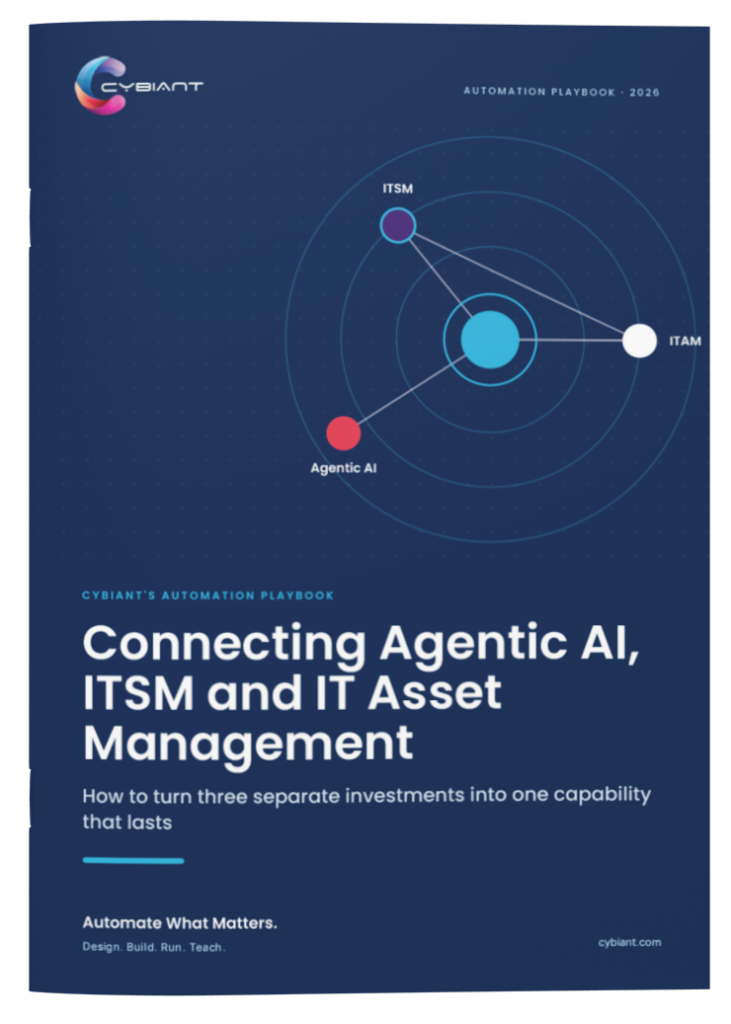
Cybiant's Automation Playbook cover

Free playbook

Cybiant’s Automation Playbook: Connecting Agentic AI, ITSM and IT Asset Management

A 14-page guide with six plays, a maturity model, guardrails and a 90 day plan.

Look inside most enterprises and you will find three investments running side by side. An ITSM platform manages requests, incidents and changes. An IT Asset Management program tracks hardware, software and cloud spend. And a growing number of AI agents are being piloted across IT and the business.

Each investment works on its own. Few of them work together. The symptoms are familiar.

01

A new hire waits a week for a laptop, because the request, the stock check and the license assignment live in three different systems.

02

Software licenses are still paid for months after people leave.

03

An agent resolves a ticket, but cannot see which device, contract or owner the ticket is about.

Agentic AI can fix this, because agents can reason across systems, decide within rules and act. But there is a catch.

An agent is only as good as the data it reads and the process it is allowed to act in.

Point an agent at an inaccurate asset register and it will make the wrong decision with full confidence, only faster.

The connected model

Record, action, execution: three layers, one capability

The playbook describes the connected enterprise as three layers, each with a distinct job.

System of record

IT Asset Management

What do we have, who owns it, and what does it cost?

System of action

IT Service Management

How is work requested, approved and delivered?

System of execution

Agentic AI

Who, or what, does the work?

The layers depend on each other. An agent without ITAM data has to guess. An agent without ITSM workflows acts without approval or an audit trail. ITSM without agents still queues work for people. And ITAM without ITSM becomes a register nobody keeps up to date.

What connects them is context. Every use case in the playbook follows the same simple loop: a signal arrives, the agent reads asset context, acts through a governed workflow, and writes the result back.
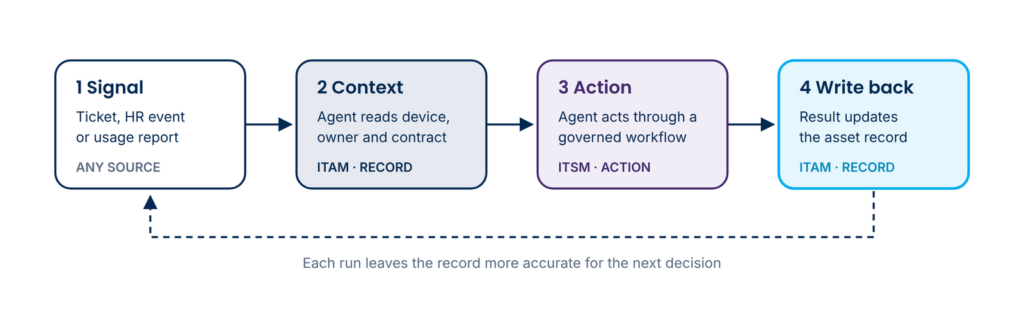
The connected loop: signal, context, action, write back

When the loop runs reliably, three separate projects become one capability that gets more accurate every time it runs.

The big idea

Agents are assets

The idea in the playbook that surprises leaders most is also the simplest: every AI agent you deploy should be managed like any other IT asset.

Organizations will soon run hundreds of agents, many built by business teams on low code platforms. Without discipline, those agents become the next wave of shadow IT. They are unknown, unowned, holding credentials, and quietly consuming paid model capacity.

IT Asset Management already has the discipline. It has decades of practice in tracking things that cost money, carry risk and reach end of life.

What that means for agents

  • A register. Every agent recorded in the CMDB, with its purpose, platform and version.
  • Owners. A named business owner and a named technical owner for each agent.
  • Entitlements. Access only to the systems, data and credentials it needs.
  • Cost tracking. Model consumption and licenses charged to the owning service.
  • Lifecycle. Clear states from proposed to retired, with regular reviews.

A quick test. Can your team say how many agents are running today, who owns each one, and what they cost last month? If any answer is “we don’t know”, start there.

Where to start

Six plays to start with

The fastest wins come from use cases that touch all three layers at once. The playbook details six, each with its trigger, agent actions, ITSM flow, ITAM impact and KPIs.

01

Joiner, mover, leaver

Assigns kit and access when people join, and reclaims devices and licenses when they leave.

Value: Day one productivity; license recovery

02

License optimization

Finds unused licenses, reclaims them, and advises before renewals.

Value: Software spend

03

Context aware incident triage

Reads device and change history from the CMDB before it classifies or fixes.

Value: Resolution time

04

Hardware refresh lifecycle

Plans refreshes from warranty and age data, through to certified disposal.

Value: Less downtime; disposal compliance

05

Smart software request

Checks for a free license or approved alternative before anything is installed.

Value: Fulfilment time; compliance

06

Continuous audit readiness

Reconciles installs against entitlements on a schedule.

Value: Audit risk

Start with one play, prove it against a baseline, then reuse the pattern for the next.

Governance

Autonomy is earned in steps

The organizations that scale agentic AI are not the ones with the boldest pilots. They are the ones whose auditors, security teams and service owners trust the agents.

Level 1

Assist

The agent gathers context and recommends. A person decides.

Level 2

Act with approval

The agent prepares and executes after sign off.

Level 3

Act autonomously

Proven, low risk, high volume work runs within set limits.

Every connected agent also needs seven guardrails: its own identity, least privilege access, vaulted credentials, written policy limits, change control, a full audit trail, and a kill switch with a named owner.

A 90 day path

From first play to proven value in 90 days

You do not need a multi year program to start. Each phase ends at a gate, passed on evidence, not on schedule alone.

Days 1 to 30

Assess and choose

Score your maturity across ITSM, ITAM and agentic AI, pick one play, and record baseline KPIs.

Days 31 to 60

Build and test

Fix the asset data the play depends on, build the agent and its workflow, and run it in assist mode.

Days 61 to 90

Run and prove

Promote the agent to act with approval, measure against the baseline, and fund the next play.

FAQ

Frequently asked questions

Agentic service automation uses AI agents that can reason, decide and act across systems to deliver IT and business services. Unlike traditional RPA, which follows fixed scripts, agents handle exceptions and make contextual decisions within defined rules.

Agents make decisions based on the data they read. ITAM provides the trusted record of devices, software, licenses, owners and costs. Without it, agents act on incomplete or wrong information.

ITSM provides the governed workflows, approvals and audit trail that make agent actions safe and accountable. Agents should act through ITSM, never around it.

The pattern is platform neutral. It works with ServiceNow or BMC Helix for ITSM and ITAM, and with UiPath or Microsoft Power Platform for agentic execution.

Pick a play where the value is clear and the asset data is good enough to fix quickly. Joiner, mover, leaver and license optimization are common starting points, because both save time and money in a measurable way.

A single connected play can move from idea to proven value in about 90 days, using a phased plan with clear gates.

Free download

Cybiant’s Automation Playbook

A 14-page guide for CIOs, Heads of ITSM, ITAM Leads and automation leaders. Inside you will find:

  • The connected model and reference architecture
  • A five level maturity model to score your organization
  • Six detailed plays with signals, actions and KPIs
  • Three levels of autonomy and seven guardrails for safe agents
  • A KPI framework and a simple business case per play
  • A 90 day plan with clear gates
Cybiant's Automation Playbook cover

Why Cybiant

Talk to the team that wrote the standard

Cybiant authored the Service Automation Framework and can design, build, run and teach connected automation, end to end. We are one of the first UiPath Agentic Automation Fast Track Partners in the world, and a certified partner of ServiceNow and BMC.

Automate What Matters.

Leave A Comment

Share this story to your favorite platform!