Automation has already reshaped the way organizations operate. From finance and HR to IT and customer service, Robotic Process Automation has helped teams eliminate repetitive tasks and improve efficiency.
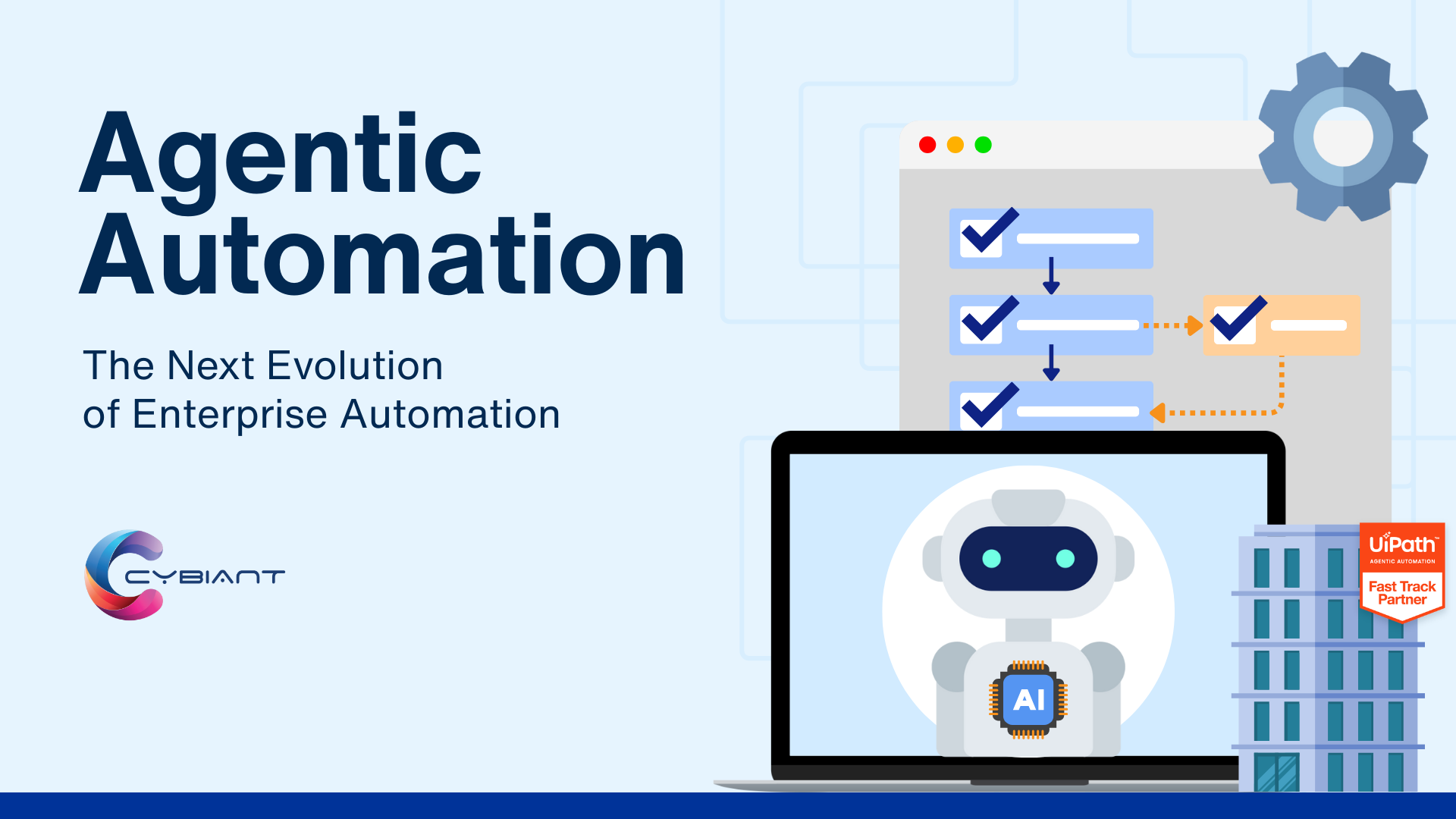
Now, a new evolution is emerging: Agentic Automation.
In our latest YouTube video, we explore what Agentic Automation really means, how it differs from traditional RPA, and how organizations can start turning intelligent automation into measurable business value.
Watch the full video here:
From Rules to Reasoning
Traditional RPA changed operations by automating repetitive, rule-based tasks, clicking through interfaces, extracting data, and filling forms. It was transformative. But it also had a hard ceiling: the moment a process deviated from its defined rules, the bot stopped, threw an error, or worse, silently failed.
Agentic Automation removes that ceiling. Rather than executing a fixed script, software agents perceive their environment, make decisions, and take actions toward a defined goal, adapting in real time when conditions change. They collaborate with other agents, handle exceptions autonomously, and improve based on outcomes.
“Agentic Automation is not just about efficiency. It is about orchestrating decisions and outcomes.”
That shift, from task execution to goal pursuit, is what makes this a genuinely new paradigm, not just RPA with a fresh coat of paint.
RPA vs. Agentic Automation at a Glance
| Capability | Traditional RPA | Agentic Automation |
|---|---|---|
| Decision-making | Rule-based only | Adaptive & goal-driven |
| Exception handling | Human escalation required | Autonomous resolution |
| Multi-system orchestration | Limited / scripted | Dynamic, multi-agent |
| Learning & improvement | Static logic | Outcome-based learning |
| Human intervention | Frequent | Minimal |
| Ideal for | Predictable, structured tasks | Complex, dynamic workflows |
How Leading Platforms Are Enabling This
The video takes a practical look at how enterprise-grade platforms are making agentic capabilities accessible today, including UiPath and Microsoft Power Automate. These aren’t experimental tools; they’re production-ready platforms that organisations are already using to deploy intelligent agents at scale.
What’s particularly exciting is the convergence of LLMs, orchestration layers, and existing automation investments. You don’t have to throw out your RPA estate; agentic capabilities can be layered on top, extending its reach into decision-heavy workflows that were previously out of bounds.
Cybiant’s Role: From Concept to Value
Understanding the technology is one thing. Deploying it securely at enterprise scale is another. As an Agentic Automation Fast Track Partner, Cybiant bridges that gap.
Our Fast Track programme covers the full journey: training your teams to think in agentic terms, implementation across your existing process landscape, and managed services to keep agents performing as your environment evolves. We help you avoid the two most common pitfalls: automating the wrong things and deploying agents without adequate governance.
The goal isn’t automation for its own sake. It’s intelligent, goal-driven automation that delivers measurable business value securely, sustainably, and at speed.
What You’ll Learn in the Video
In under ten minutes, the video covers:
- A clear, jargon-free definition of Agentic Automation
- The core differences from traditional RPA and why they matter
- How UiPath and Microsoft Power Automate enable agentic capabilities today
- How Cybiant’s Fast Track approach accelerates time-to-value
Whether you’re an automation leader evaluating your next strategic move or a technology buyer trying to make sense of the vendor landscape, this video gives you the foundation to have more informed conversations.
Get Social