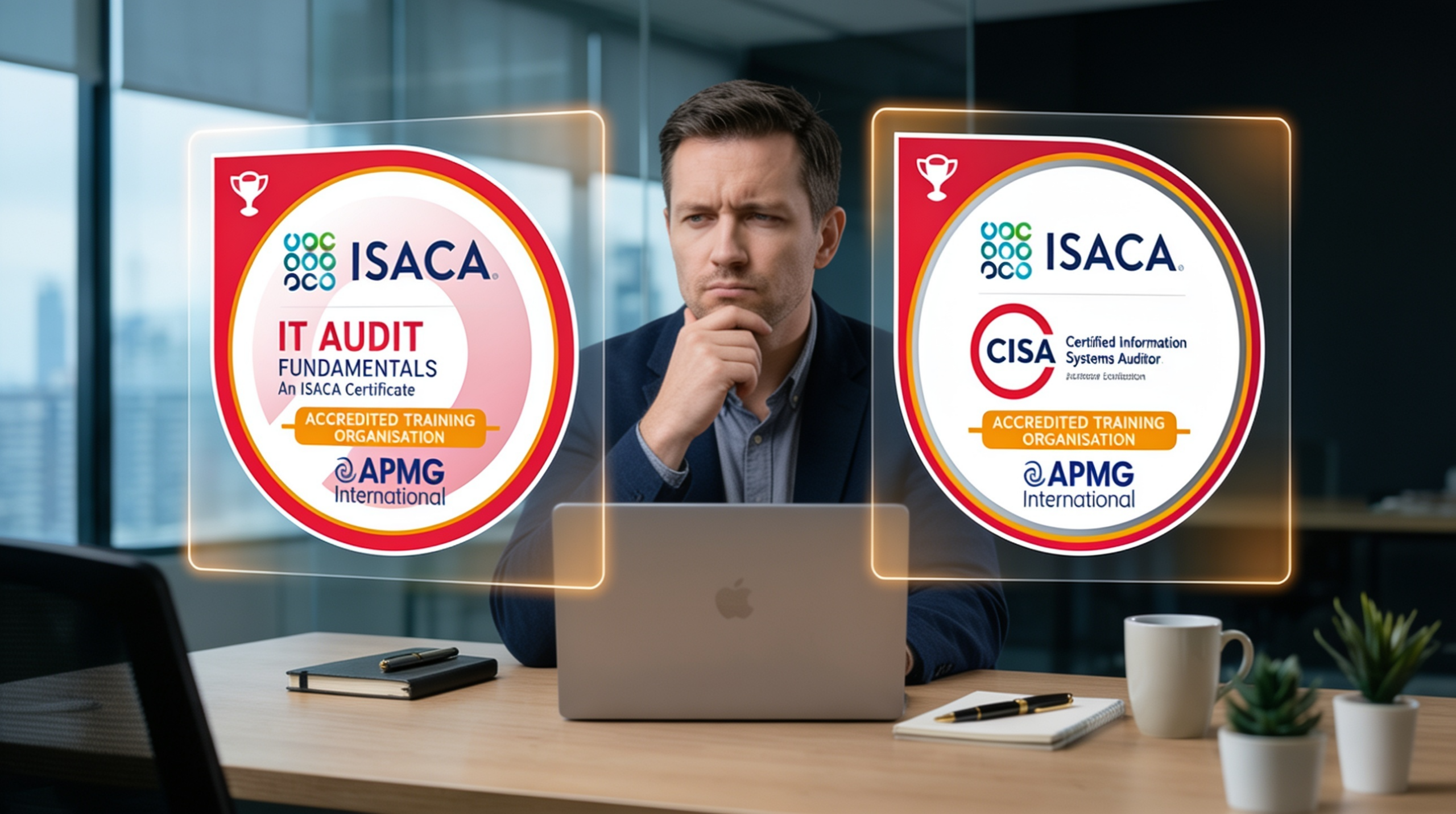
If you’re exploring a career in IT audit, you’ve likely come across two ISACA credentials that sound like they cover similar ground. They’re related, but built for different people, at different points in their careers, solving different problems.
This article breaks down what each certification actually is, who it’s for, and how to decide which one, or which order, makes sense for you.
The Short Answer
| IT Audit Fundamentals | CISA | |
|---|---|---|
| What it is | An entry-level course covering the basics of IT audit | A globally recognized professional certification |
| Who it’s for | Newcomers to IT audit, risk, or compliance | Experienced IT auditors and audit/risk leaders |
| Prerequisites | None | None to sit the exam, but 5 years of relevant work experience to earn the certification |
| Format | 3-day instructor-led course | Exam-based certification + structured exam prep training |
| Outcome | Foundational knowledge and a course completion | A certification recognized as the global standard for IT audit professionals |
| Best starting point if you… | Are new to audit and need the vocabulary and method | Already work in audit/IT/security and are ready to formalize that experience |
If you are unsure which to choose: if you have never been formally trained in IT audit, start with Fundamentals. If you already have IT audit, security, or risk experience and want the credential that proves it, go straight to CISA.
The Real Difference: Depth, Not Just Difficulty
It is tempting to think of these as “beginner” and “advanced” versions of the same thing. That is only half right. The more important difference is what each one is certifying.
- IT Audit Fundamentals certifies that you understand how IT audit works. It is knowledge-based. You leave the course able to speak the language of audit and apply its core methods.
- CISA certifies that you have already done IT audit work, at a professional standard, for years. It is experience-based, with the exam serving as a rigorous test of whether your practical knowledge matches the global standard ISACA has defined.
This is why a motivated newcomer can complete Fundamentals in a long weekend but cannot shortcut their way into a CISA designation no matter how well they study — the credential is partly a function of time and practice, not just test performance.
Can You Go Straight to CISA?
Yes — if you already meet the experience requirement. There is no rule that says you must complete Fundamentals first. Many experienced IT auditors, security professionals, and risk managers go directly into CISA exam preparation because they already have the years of hands-on practice the certification requires.
Fundamentals exists for the other case: professionals who have the adjacent experience (IT operations, security, compliance, general business) but have not had formal exposure to audit methodology, and want to build that foundation, whether or not they intend to pursue CISA afterward.
A Common, Deliberate Pathway
For professionals building toward a long-term audit career:
ISACA IT Audit Fundamentals → gain qualifying work experience → CISA
This sequencing means you enter your audit experience years already speaking the right language and using the right methodology, rather than learning audit fundamentals informally on the job, while the clock on your CISA-qualifying experience is already running.
Which One Should You Choose?
- 1
Have I had formal training in IT audit methodology before?
If no → start with IT Audit Fundamentals. - 2
Do I already have 5+ years of relevant audit, security, risk, or assurance experience?
If yes → go straight to CISA exam preparation. - 3Am I trying to move into audit from an adjacent IT or risk role?Build the foundation with Fundamentals first, then work toward CISA once you’ve accumulated qualifying experience.
There’s no wrong choice here, only a mismatch between where you currently are and which course assumes you already are. Fundamentals assumes no audit background. CISA assumes a meaningful one.
