

Enterprise automation has reached an inflection point. RPA and Intelligent Automation have delivered real gains, but they remain constrained by predefined logic and rigid workflows. As operational complexity grows, a new paradigm is emerging: Agentic Automation. These are systems that interpret goals, reason about actions, and adapt in real time.
Cybiant’s latest whitepaper, Getting Started with Agentic Automation in the Enterprise, is a practical guide for enterprise leaders who want to move beyond experimentation and into responsible, scalable deployment of agentic AI. This article captures the key themes and insights from the whitepaper.
From Automation to Autonomy: Why the Shift Is Happening Now
The evolution of enterprise automation has moved through distinct phases, starting from basic scripts and macros, moving to RPA mimicking human UI interactions, and then to Intelligent Automation layering in machine learning. Each wave brought efficiency gains. But each also revealed the same fundamental limitation: systems bound to the paths their designers could predict.
Modern enterprises operate in environments that defeat static logic. Supply chains shift overnight. Regulations evolve. Customer expectations change. In this context, the inability of traditional automation to handle variability becomes a strategic liability.
Agentic Automation addresses this gap by enabling systems to reason, plan, and adapt within defined boundaries. Rather than encoding every possible path, enterprises define goals, policies, and constraints, and agents determine how to achieve objectives dynamically. Autonomy moves from innovation to operational necessity.
What Makes a System Truly “Agentic”?
A common misconception is equating agentic systems with conversational AI or chatbots. The whitepaper is clear: enterprise agents are not chat interfaces. They are embedded within operational environments, invoking APIs, executing automations, validating outcomes, and operating under strict governance.
Agentic systems operate across a spectrum of autonomy, from agents that only recommend actions to fully autonomous systems operating under strict policy constraints. The whitepaper defines three levels:
Most enterprises should start with advisory or semi-autonomous models. As governance matures and trust is established, the scope of autonomy can be responsibly extended.
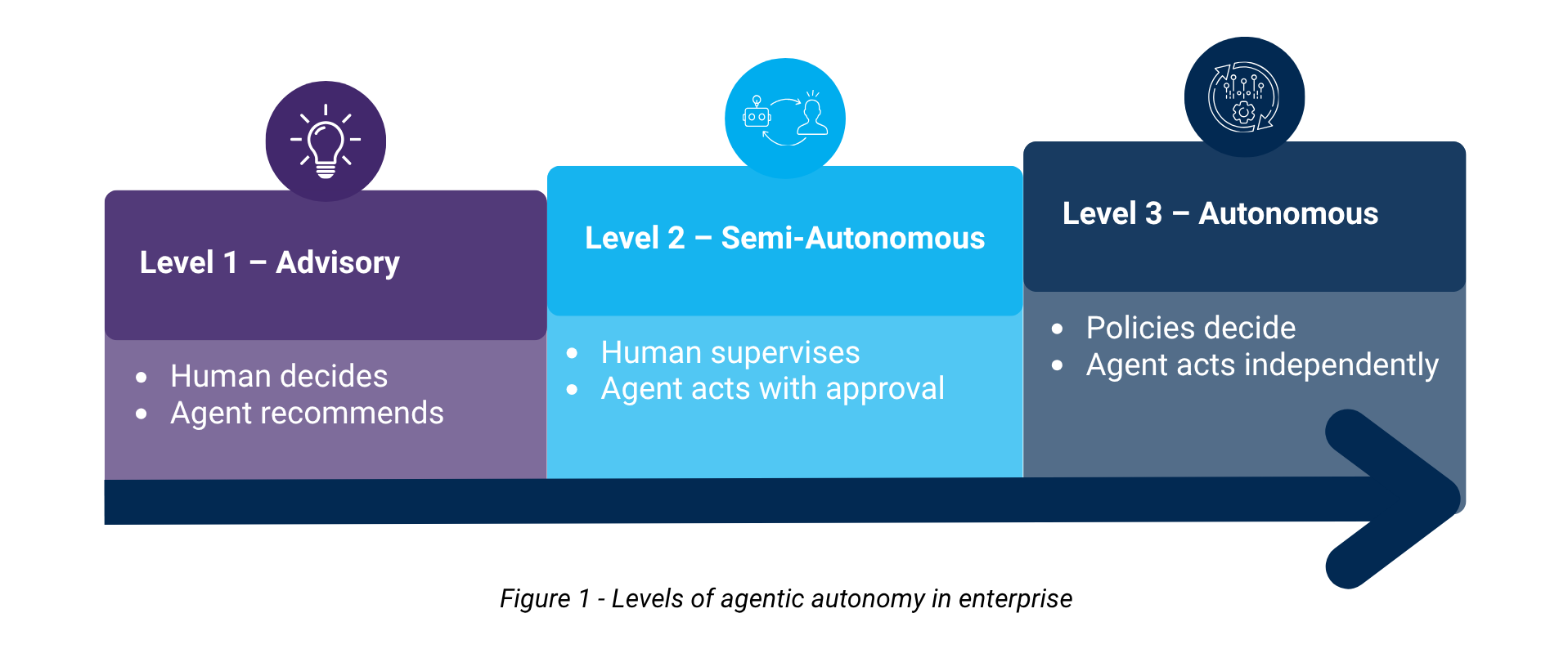
Most enterprises should start with advisory or semi-autonomous models. As governance matures and trust is established, the scope of autonomy can be responsibly extended.
“Value creation emerges when agents are integrated into core business processes, not as standalone assistants.”
Where Agentic Automation Delivers Enterprise Value
The whitepaper identifies several domains where agentic systems deliver differentiated value, particularly where processes are high-variability, cross-system, or knowledge-intensive:
Architecture: Building for Controlled Autonomy
Agentic Automation requires a fundamentally different architectural approach. Rather than linear workflows, enterprise agentic architectures are built around decision loops, context awareness, and controlled autonomy. The whitepaper defines five logical layers: from intent and goals at the top, through reasoning, orchestration, and execution, to an all-encompassing governance layer:
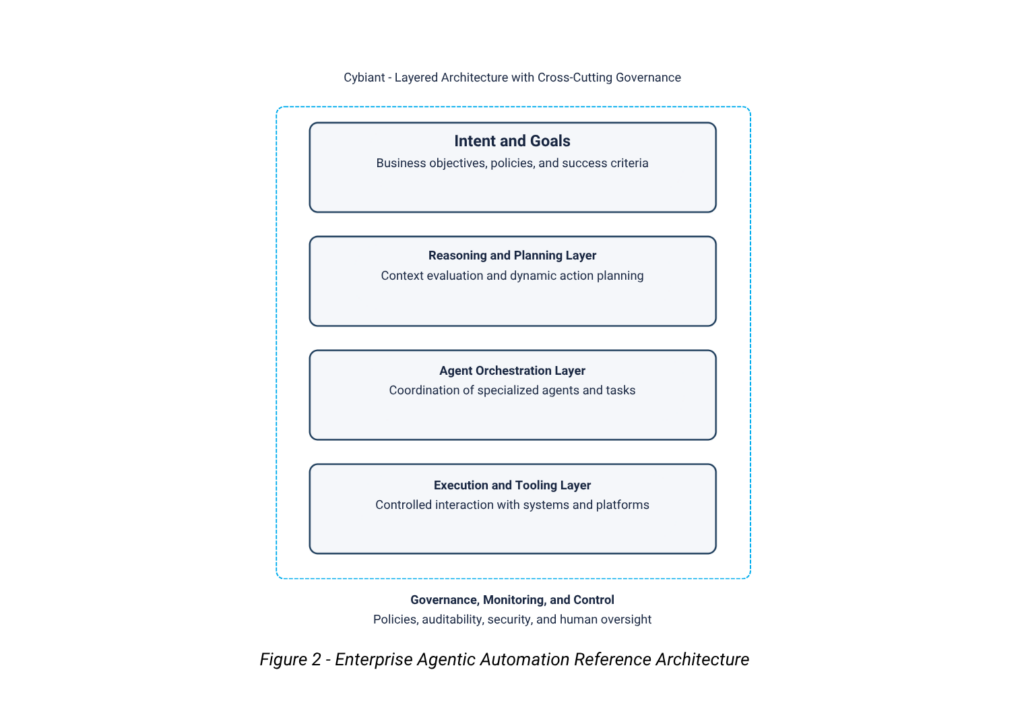
A critical design principle is the explicit separation between decision-making and execution. Agents decide what should be done; a governance gate validates whether it should be done. Execution only occurs after actions pass predefined checks, thresholds, and approval requirements:

Equally important is observability by design. Unlike traditional automation, agentic systems reason dynamically. Enterprises must be able to see not only what an agent did, but why, capturing intent, reasoning steps, actions taken, and deviations. Observability must be baked into architecture from day one, not bolted on after deployment.
Governance Is Not Optional. It Is the Foundation
The whitepaper is emphatic: governance is not an enhancement; it is the condition that makes agentic automation viable at enterprise scale. In traditional automation, failures are localized and predictable. In agentic systems, failures can propagate across systems, processes, and organizational boundaries.
Effective governance in agentic automation rests on three interdependent elements:
Data security and privacy are equally critical. Agents must be treated as first-class identities within the enterprise security model, operating under least-privilege principles with strict data handling and regulatory compliance enforced throughout the agent lifecycle.
The Agentic Automation Maturity Model
One of the most practical contributions of the whitepaper is a five-level maturity model that helps enterprises understand where they are and how to advance responsibly, from manual scripted operations through to fully managed autonomous operations:
Most successful enterprise implementations currently operate at Level 4: Semi-Autonomous Agentic Systems, balancing autonomy with human supervision and exception handling. The key insight: use the maturity model as a planning tool, not a scorecard. Advance incrementally, selecting use cases aligned with current readiness and investing in governance before scaling autonomy.
Lessons Learned from Real Implementations
The whitepaper draws on real-world enterprise implementations to identify patterns that consistently determine success or failure. Common pitfalls to avoid:
What consistently works: start small, embed agents into existing processes, maintain clear human oversight, measure outcomes not just efficiency, and invest in governance from day one.
“Agentic Automation is not a technology project. It is an organizational capability.”
The Future: Governance as Competitive Advantage
In the long term, competitive advantage will not come from who deploys agentic systems first. It will come from who governs them best. Organizations with mature governance frameworks move faster, not slower. Clear policies, controls, and accountability mechanisms reduce internal friction, shorten approval cycles, and accelerate deployment.
Human roles will evolve alongside these systems, shifting toward defining goals and intent, designing policies and constraints, supervising agent behavior, and making strategic and ethical judgments. Enterprises that invest now in architecture, governance, and organizational readiness will be better positioned to leverage increasing autonomy without sacrificing control or trust.
Read the Full Study
The complete 36-page guide includes a one-page Enterprise Readiness Assessment Checklist, detailed implementation roadmap, and all reference architecture diagrams.
Download the White Paper
Free access. We may occasionally share relevant research from Cybiant — unsubscribe any time.